
EtherChannel bundles multiple physical links into one logical Port-Channel: more bandwidth, redundancy — and one STP link instead of several.
Hardware rules
- All member links same speed; up to 16 configured, max 8 active per port-channel (rest standby).
Protocols & negotiation
| Mode pair | PAgP (Cisco) | LACP (802.3ad) |
|---|---|---|
| desirable/desirable · desirable/auto · active/active · active/passive | ✅ forms | ✅ forms |
| auto/auto · passive/passive | ❌ down | ❌ down |
| on (no negotiation) | ⚠️ forced up — not STP-detectable, loop risk; Cisco discourages | |
Rule of thumb: PAgP needs desirable on at least one side; LACP needs active on at least one side — best practice active/active.
What must match
Layer (L2 vs L3), speed, duplex, switchport mode, access VLAN or allowed-VLAN list + native VLAN, channel-group number, protocol.
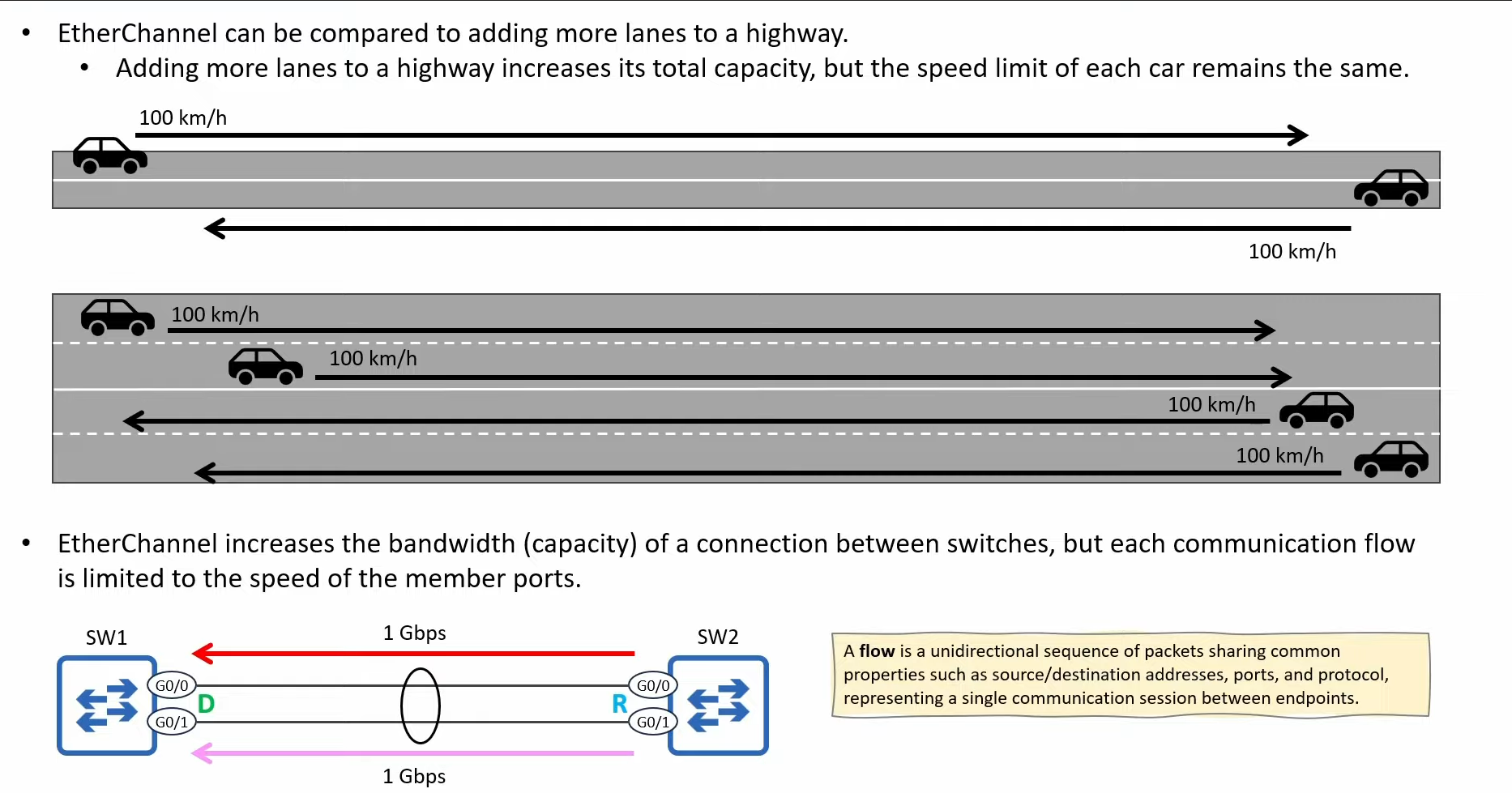
Load balancing is hashing, never per-packet
port-channel load-balance src-dst-ip   # Cisco default best practice
show etherchannel load-balance
src-dst-port distributes best but is platform-dependent (DC designs). Per-packet would reorder TCP.
Config (best practice)
interface range gi1/0/1-2
 switchport mode trunk
 channel-group 1 mode active
!
interface port-channel 1        ! configure everything on the master
 switchport trunk allowed vlan 10,20,30
CCNP extras: lacp system-priority / lacp port-priority decide which links go active; lacp max-bundle 4 caps active links. Verify with show etherchannel summary (flags P=active, S=standby, s=suspended, I=individual).
Common faults
| Fault | Result |
|---|---|
| VLAN mismatch | interface suspended |
| speed/duplex mismatch | no bundle |
| passive + passive | no adjacency |
| one side “on” | loop risk |