
IPv6 is the next generation of IP, designed to replace IPv4 because IPv4 ran out of addresses and needs workarounds like NAT.
👉 IPv6 provides enough addresses for the whole planet, better routing and simpler network design.
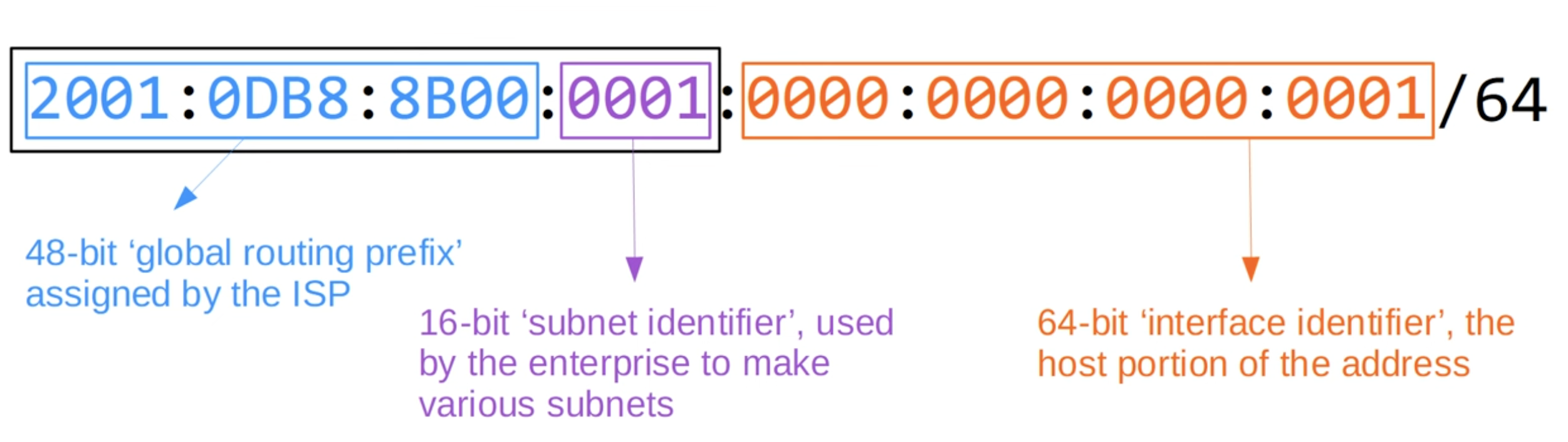
Basic facts
- Address length: 128 bits
- Notation: hexadecimal (0–9, a–f)
- Example:
2001:0db8:abcd:0012:0000:0000:0000:0001→ shortened2001:db8:abcd:12::1 - OSI layer: Layer 3
- Broadcast: ❌ does not exist in IPv6 · Multicast: ✅ used instead
Address structure
| Network/Prefix (routing) | Interface ID (host) |Typical: 2001:db8:1000:1::/64 — /64 is the standard subnet (very important): first 64 bits = network, last 64 bits = host.
⚠️ SLAAC only works with /64 (classic exam trap).
IPv6 address types (the important ones)
Global Unicast
- Globally routable — IPv6’s answer to public IPv4 · prefix
2000::/3· used on the internet · the most common type · hierarchical (ISP → site → subnet → interface), supports summarization.
Link-Local
- Automatically generated (mandatory) · prefix
FE80::/10· valid only on the local link · not routable - Used by: Neighbor Discovery, routing protocols (OSPFv3, EIGRPv6, BGP next-hop)
- ⚠️ OSPFv3 adjacencies require link-local; routing cannot work without it
Unique Local (ULA)
- Private IPv6 · prefix
FC00::/7(in practiceFD00::/8) · not routed on the internet - IPv6’s answer to
10.0.0.0/8/192.168.0.0/16
Multicast
- One-to-many · prefix
FF00::/8· scope field defines reach · replaces broadcast - Key addresses:
FF02::1all nodes,FF02::2all routers
How does a device get an IPv6 address?
SLAAC (Stateless Address Autoconfiguration)
- The router sends Router Advertisements (RA); the client learns the prefix and generates its own interface ID.
- ✅ No DHCP server needed · ❌ no central control
DHCPv6
- Stateless (extra info only) or stateful (full address assignment)
- CCNP: understand the interplay between RA and DHCPv6
EUI-64 (automatic interface ID)
- The MAC address is split in two
FFFEis inserted in the middle- The U/L bit (7th bit) is inverted
Status: still in the books, less used in practice (privacy extensions preferred) — but still exam material.
IPv6 subnetting (very simple)
Subnetting happens on the prefix, never on the host part:
2001:db8:1000::/48
 → 2001:db8:1000:1::/64
 → 2001:db8:1000:2::/64
Special IPv6 addresses
| Address | Meaning |
|---|---|
:: |
Unspecified |
::1 |
Loopback |
2001:db8::/32 |
Documentation (never in production) |
::ffff:x.x.x.x |
IPv4-mapped |
Why is IPv6 better than IPv4?
- No NAT needed · better routing and summarization · built-in IPsec support · simpler neighbor discovery · (effectively) endless address space
Classic exam traps ⚠️
- SLAAC +
/56→ ❌ wrong · OSPFv3 without link-local → ❌ · “broadcast” in IPv6 → ❌ (doesn’t exist) · forgetting multicast scope → ❌
Exam tips ⚠️
- OSPFv3 / EIGRPv6 problems? → check link-local
- SLAAC not working? → check /64
- “no broadcast”? → think multicast
- ULA vs Global? → a design choice
30-second summary
- 128-bit, hierarchical, no broadcast ·
/64is king · link-local is critical for routing · multicast replaces broadcast · SLAAC + DHCPv6 = address management
| Level | Expectation |
|---|---|
| CCNA | Types, notation, SLAAC, subnetting |
| CCNP | Design, summarization, routing behaviour, troubleshooting |