
IPv6 address formats define the purpose and scope of an address – routing, local communication, multicast or special use.
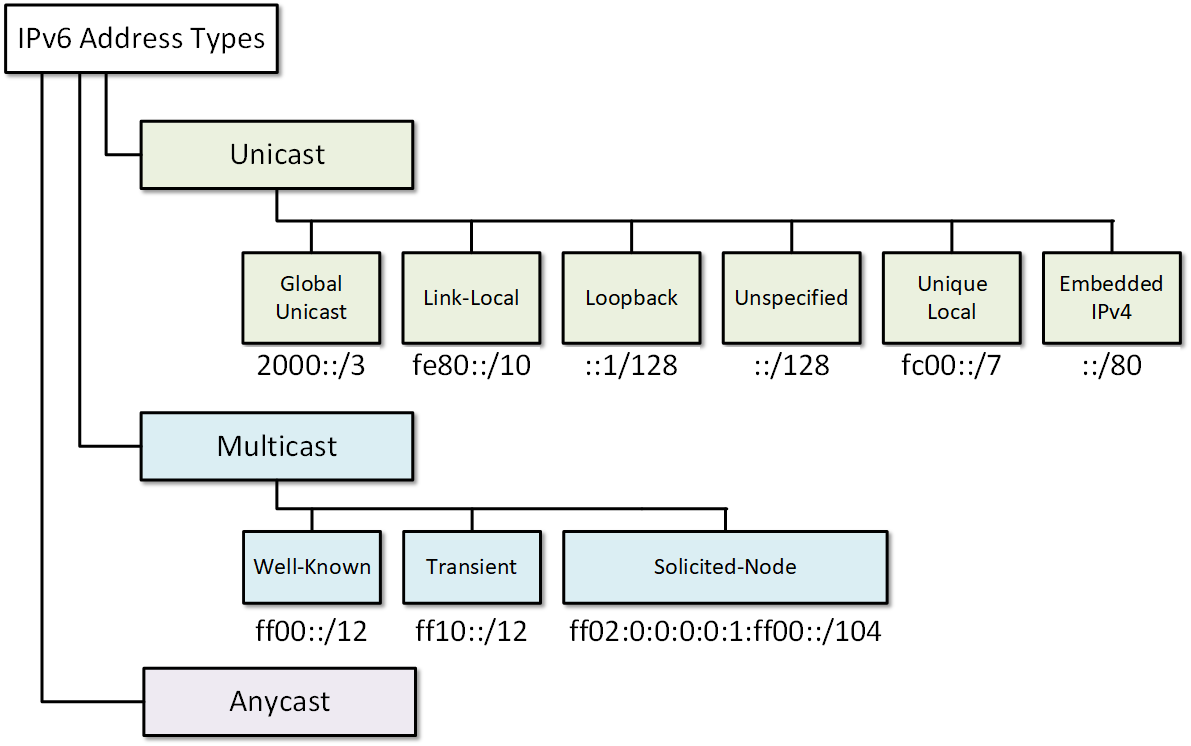
Address formats (what you must know)
| Type | Prefix / format | Scope | Use | Exam notes |
|---|---|---|---|---|
| Global Unicast (GUA) | 2000::/3 |
Global | Normal routable IPv6 address | The most used IPv6 address |
| Link-Local | FE80::/10 |
Link | Neighbor Discovery, routing protocols | Automatically generated |
| Unique Local (ULA) | FC00::/7 (typically FD00::/8) |
Private | Internal network (IPv6 “private”) | Not routable on the internet |
| Multicast | FF00::/8 |
Varies | One-to-many | Replaces broadcast |
| Anycast | No fixed prefix | Varies | Same address on several devices | Routing picks the nearest |
| Loopback | ::1/128 |
Local | Test local TCP/IP stack | IPv6 pendant to 127.0.0.1 |
| Unspecified | ::/128 |
Local | “No address yet” | Used before an address is assigned |
| IPv4-Mapped IPv6 | ::FFFF:IPv4 |
Local | IPv4 inside an IPv6 stack | Mostly theoretical |
| IPv4-Compatible | ::IPv4 |
Deprecated | Early transition method | ❌ No longer used |
| Documentation | 2001:DB8::/32 |
Documentation | Examples in books/labs | Never used in production |
Multicast – the ones Cisco loves to test 🧠
| Multicast address | Use |
|---|---|
FF02::1 |
All nodes |
FF02::2 |
All routers |
FF02::5 |
OSPFv3 routers |
FF02::6 |
OSPFv3 DR/BDR |
FF02::A |
EIGRPv6 |
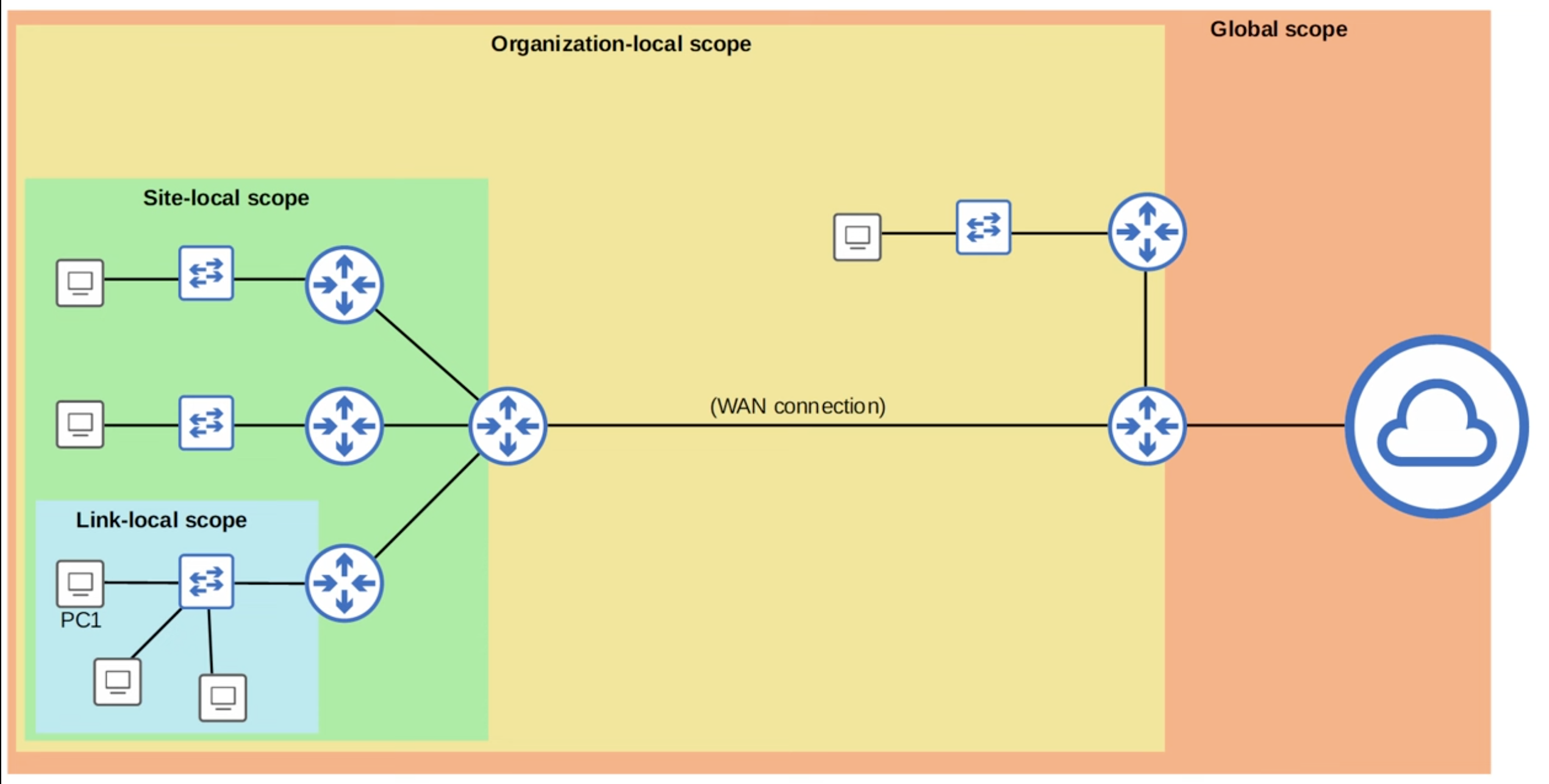
Multicast scopes:
Structure: Global Unicast Address (GUA)
| Global Routing Prefix | Subnet ID | Interface ID |
|         /48           |    /16    |     /64        |
➡️ Standard subnet = /64 (Key Topic)
Quick exam guide
- Routable on the internet? → Global Unicast
- Router talking to a neighbor? → Link-Local
- Private IPv6 network? → ULA
- One-to-many? → Multicast
- Test locally? →
::1 - No address yet? →
::
CCNA vs CCNP focus
| Level | Focus |
|---|---|
| CCNA | GUA, Link-Local, Multicast, Loopback |
| CCNP | ULA, Anycast, multicast scopes, routing usage |