
VRF (Virtual Routing and Forwarding) lets one router keep several separate routing tables, so traffic is logically isolated on the same physical device.
Facts
- Function: several independent routing tables on one router · OSI: Layer 3
- Standard: no official RFC for VRF-Lite (MPLS L3VPN = RFC 4364)
- IP overlap: ✅ allowed · RD (Route Distinguisher) makes overlapping prefixes unique
- One routing table + one routing process per VRF; VRF-to-VRF traffic only via manual route leaking
- Used for: enterprise segmentation (guest/production/management), MPLS L3VPN, service providers, multi-tenant datacenter, labs
- CCNA: understand the concept · CCNP: configure, troubleshoot, MPLS integration
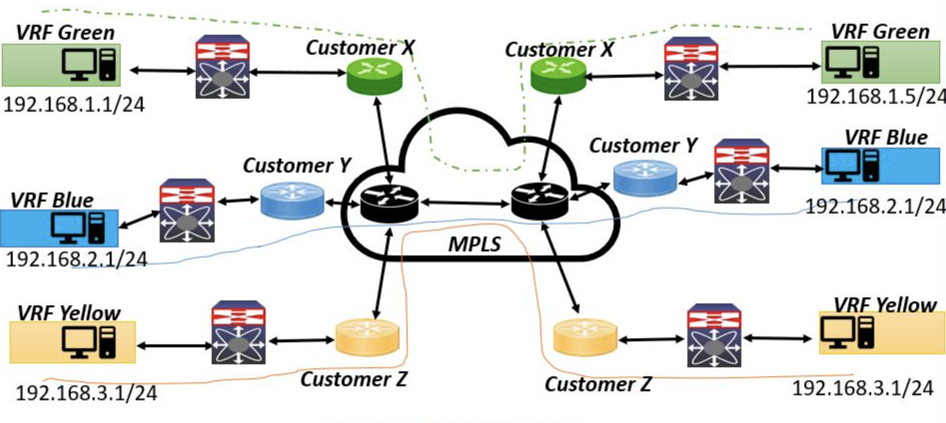
Why does it exist?
Without VRF: only one global routing table – overlapping IP addresses impossible, no logical separation, hard to design multi-tenant, no isolation between customers/departments.
How it solves it
VRF creates a separate routing table, a separate CEF table, a separate forwarding instance and separate routing processes (OSPF/EIGRP/BGP). The router behaves like multiple virtual routers in one chassis – distributed logic, each VRF with its own control-plane instance.
Step by step
- Create the VRF – the router builds a new routing context
- Bind interfaces – they move from the global table to the VRF table
- Configure routing inside the VRF
- Forwarding – lookups only happen in the VRF’s table
- Failure – only the affected VRF is impacted, not global routing
Key terms
| Term | Explanation |
|---|---|
| VRF | Virtual routing table |
| VRF-Lite | VRF without MPLS |
| RD | Route Distinguisher (makes prefixes unique in MPLS) |
| RT | Route Target (MPLS import/export) |
| Route leaking | Sharing routes between VRFs |
| VRF-aware routing | A routing process bound to a VRF |
| vpnv4 | BGP address-family for MPLS VPN |
Elements
| Element | Description | CCNA | CCNP |
|---|---|---|---|
| VRF | Isolates routing | ✔ | ✔ |
| VRF-Lite | Without MPLS | ✖ | ✔ |
| MPLS L3VPN | Provider VPN | ✖ | ✔ |
| Route leaking | Sharing between VRFs | ✖ | ✔ |
Routing protocols in VRF
Each VRF has its own RIB, CEF table and routing process. OSPF, EIGRP and BGP all run per VRF:
| Protocol | VRF support | Notes |
|---|---|---|
| OSPF | ✔ | Separate process per VRF |
| EIGRP | ✔ | Named mode recommended |
| BGP | ✔ | Address-family vrf |
| RIP | ✔ | Rarely used |
MPLS case: the PE router runs MP-BGP, routes are exported with RD/RT, label stack does the forwarding: Customer → CE → PE → MP-BGP → core → PE → CE.
Dependencies
- CEF must be enabled · routing process must use the VRF keyword
- MPLS requires LDP and MP-BGP
- Hardware TCAM limits can cap the number of VRFs
- Security: VRF gives routing isolation – it is not a firewall
Configuration
VRF definition:
vrf definition VRF_A
 rd 100:1
 address-family ipv4
 exit-address-family
!
vrf definition VRF_B
 rd 100:2
 address-family ipv4
 exit-address-family
Interfaces in VRF – subinterface (802.1Q):
interface GigabitEthernet0/0.10
 encapsulation dot1Q 10
 vrf forwarding VRF_A
 ip address 10.10.10.1 255.255.255.0
Physical interface, loopback or SVI work the same way. Note: vrf forwarding <VRF> removes the IP address – set the IP after the VRF binding.
Routing per VRF:
! Static
ip route vrf VRF_A 0.0.0.0 0.0.0.0 10.10.10.254

! OSPF
router ospf 1 vrf VRF_A
 network 10.10.10.0 0.0.0.255 area 0

! EIGRP named mode
router eigrp CUSTOMER_A
 address-family ipv4 vrf VRF_A autonomous-system 10
  network 10.10.10.0 0.0.0.255

! BGP
router bgp 65000
 address-family ipv4 vrf VRF_A
  neighbor 10.1.1.2 remote-as 65010
  network 10.1.1.0 mask 255.255.255.0
Route leaking (only if VRFs must reach each other):
! Simple static
ip route vrf VRF_A 10.20.20.0 255.255.255.0 GigabitEthernet0/0.20
! Nicer static via next-hop
ip route vrf VRF_A 10.20.20.0 255.255.255.0 10.20.20.254
! (BGP-based and MP-BGP RT import/export also exist)
Verification / troubleshooting
show vrf
show vrf detail
show ip interface brief vrf VRF_A
show ip route vrf VRF_A
show ip protocols vrf VRF_A
show ip cef vrf VRF_A
show bgp vpnv4 unicast all
ping vrf VRF_A 10.10.10.100
traceroute vrf VRF_A 8.8.8.8
Typical faults
- ❌ OSPF adjacency won’t come up – the router runs global OSPF instead of VRF OSPF →
router ospf 10 vrf NAME - ❌ Route exists globally but not in the VRF – wrong address-family or missing network statement
- ❌ BGP neighbor down – missing activation under
address-family ipv4 vrf; also check that both sides are in the same VRF
Design & best practices
- One routing protocol per VRF · avoid unnecessary route leaking · plan the RD/RT structure in MPLS · watch control-plane load
Exam tips ⚠️
- CCNA: know what VRF is and that routing is isolated
- CCNP: overlapping IPs, MPLS L3VPN,
address-family ipv4 vrf→ think routing in VRF
30-second summary
- Each VRF has its own routing process · OSPF/EIGRP/BGP run per VRF · MPLS uses MP-BGP · route leaking is advanced CCNP · global routing stays separate from VRF routing